
What are microchannel cold plates and skived-fin cold plates?
As the power density of AI servers, GPUs, and high-power electronic devices continues to rise, liquid cooling has emerged as a crucial thermal management solution. Cold plates facilitate heat transfer from electronic components to the coolant by allowing the fluid to flow through internal channels.
Microchannel cold plates and skived-fin cold plates represent two common design approaches, each with distinct characteristics regarding heat transfer capability, flow resistance, and manufacturing processes.
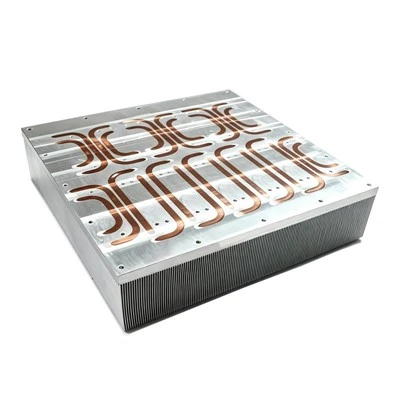
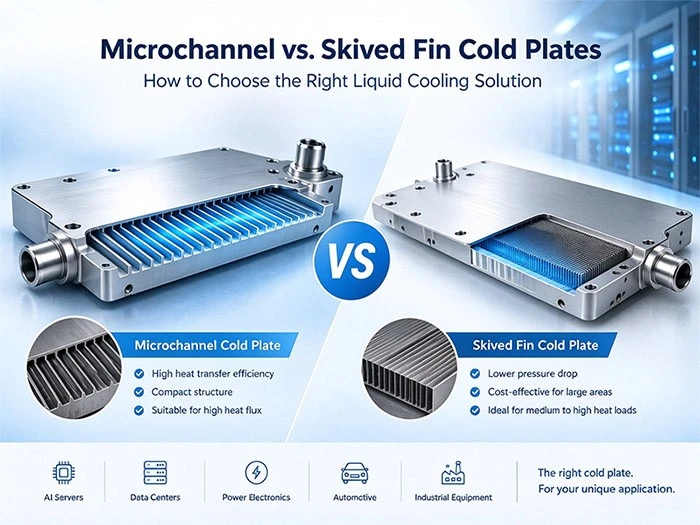
Microchannel cold plates utilize small-scale flow channels to provide a large heat transfer surface area within a compact footprint, thereby enhancing heat transfer efficiency; they are well-suited for applications demanding high thermal performance.
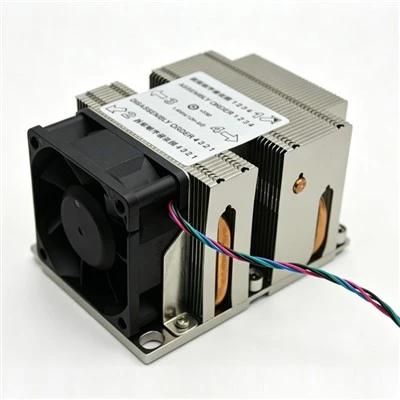
Skived-fin cold plates are manufactured using a skiving process, in which a portion of the metal base material is sliced and bent upward to form continuous, thin fins. As coolant flows through the channels between these fins, it carries away the heat transferred from the heat-generating components.
It is important to note that "skiving" refers to a manufacturing process, whereas "microchannel" describes the dimensions or structural characteristics of the flow channels; the two concepts are not mutually exclusive. This article focuses on comparing the selection considerations for typical microchannel designs versus typical skived-fin cold plate designs in practical applications.
Why does superior heat dissipation capability not necessarily equate to a better overall solution?
While microchannels can enhance heat dissipation by increasing heat-transfer surface area and optimizing flow-path architecture, a higher heat-transfer capacity does not automatically guarantee a more efficient liquid-cooling system.
As coolant flows through these channels, it experiences pressure loss-commonly referred to as "pressure drop." Factors such as channel dimensions, length, geometry, and flow rate all influence this pressure drop. Certain microchannel designs require a higher pressure differential to achieve the target flow rate, which complicates pump selection and overall system design.
Furthermore, smaller flow channels necessitate stricter control over coolant cleanliness. The ingress of particulate matter or sediments can lead to blockages, impairing coolant flow and compromising the stability of heat dissipation.
Therefore, when evaluating a cold plate, one should not focus solely on its peak heat-dissipation capacity; rather, the following factors must also be considered:
• Heat-dissipation performance: Can the component temperature be maintained within the permissible range?
• Pressure drop and pumping energy consumption: How much pressure and pumping power are required to sustain the necessary flow rate?
• Manufacturing costs: Do the machining precision, production efficiency, and product consistency meet project requirements?
• Operational reliability: Are aspects such as coolant management, the risk of clogging, and long-term maintenance effectively controlled?
An optimal solution is one that achieves a well-balanced compromise between performance, cost, and reliability, all while meeting the core heat-dissipation requirements.
What are the respective advantages of microchannel cold plates and skived-fin cold plates?
1. Microchannel Cold Plates: Suited for High Heat-Transfer Requirements
Microchannels provide a large heat-transfer surface area within a compact space, making them valuable for cooling high-power chips and electronic devices with high heat-flux densities.
However, their actual performance depends on factors such as channel dimensions, inlet and outlet configurations, coolant flow rate, and overall thermal resistance. Smaller channels do not necessarily guarantee better heat dissipation, as flow resistance, flow distribution, and manufacturing precision all significantly influence performance.
When employing microchannel solutions, it is essential to carefully consider the pressure-drop budget, coolant cleanliness, and manufacturing quality, and to verify overall performance through testing.
2. Skived-Fin Cold Plates: Balancing Heat-Transfer Design with Manufacturability
Skived-fin cold plates utilize continuous fins to increase heat-transfer surface area. The thickness, spacing, and height of the fins, as well as the layout of the flow channels, can be tailored to specific application requirements.
For product structures compatible with the skiving process, mature manufacturing techniques help ensure production consistency while allowing for cost optimization and customized designs.
Nevertheless, the performance of skived-fin cold plates is constrained by their structural design. Excessively narrow fin spacing can increase flow resistance and complicate both the manufacturing and cleaning processes. Therefore, fin geometric parameters must be carefully aligned with the target flow rate, thermal load, and manufacturing capabilities.
Both microchannel and skived-fin cold plates can achieve efficient liquid cooling. The optimal choice depends on the specific thermal load, structural design, and system conditions, rather than being determined solely by the name of the technology.
How to Select an Appropriate Cold Plate Structure?
When selecting a cold plate, consider the following four aspects:
First, define the heat load and temperature requirements.
You must determine the actual power consumption of the components, the heat-dissipation surface area, the presence of localized "hot spots," and the allowable operating temperature range. For high-power components like GPUs, it is essential to consider not only the total power consumption but also the local heat flux density and temperature uniformity.
Second, evaluate flow rate and pressure drop constraints.
A cold plate must function in coordination with other cooling system components, such as pumps, piping, manifolds, and fittings. During the design phase, verify the flow rate and pressure differential that the system can provide, ensuring that the flow resistance of the cold plate itself does not adversely affect the operation of the entire cooling loop.
Third, compare manufacturing costs and production capabilities.
Different structures impose varying requirements on machining precision, equipment capabilities, and quality control. Manufacturing costs should be evaluated holistically-taking into account product dimensions, production volume, materials, fabrication processes, and inspection standards-rather than judging price solely based on structural complexity.
Fourth, verify long-term operational reliability.
Assess factors such as coolant compatibility, filtration requirements, contamination control, pressure resistance, and maintenance needs based on the specific application. For high-power equipment, the design must also be validated through thermal performance testing, pressure drop analysis, and necessary durability testing to ensure it meets all operational requirements.

When should microchannel or skived-fin cold plates be prioritized?
If a device features high local heat flux and is constrained by limited installation space, it is advisable to evaluate enhanced heat transfer structures, such as microchannels. However, one must also ensure that the pressure drop, pumping capacity, coolant cleanliness, and manufacturing costs meet the project requirements.
If a skived-fin cold plate is already sufficient to satisfy the device's temperature limits, system flow requirements, and reliability standards, it is generally better to stick with the skived-fin design to keep overall costs and system complexity under control; there is no need to switch to a different solution simply because microchannels offer a higher theoretical heat transfer capacity.
If an existing skived-fin structure fails to meet thermal management requirements, one may then compare it against microchannels or other enhanced heat transfer solutions, using simulations and experiments to determine the actual performance gains.
There is no universal heat flux threshold that applies to all equipment. The same heat flux value may necessitate entirely different cold plate designs depending on factors such as the heat-generating surface area, coolant inlet temperature, flow rate, and specific temperature constraints.
Conclusion
Microchannel cold plates offer high heat-transfer potential, making them suitable for applications with demanding cooling requirements; however, factors such as pressure drop, coolant management, and manufacturing specifications must be carefully considered.
Skived-fin cold plates provide effective heat dissipation through flexible fin designs, offering a balance of manufacturing feasibility, cost, and system performance for appropriate applications.
When selecting cold plates for AI servers, GPUs, and other high-power electronic equipment, the focus should not solely be on maximizing heat-transfer capacity. Instead, one must holistically evaluate thermal load, allowable pressure drop, pumping power consumption, manufacturing costs, and long-term reliability.
The optimal cold plate is not necessarily the one with the highest heat-transfer capacity, but rather the one that can reliably meet cooling requirements under actual system conditions while achieving an ideal balance between overall performance and cost.