
What Is a Liquid Cold Plate in a Solid-State Transformer?
How Do Liquid Cold Plates Help Solid-State Transformers Achieve Higher Power Density and More Efficient Thermal Management?
As AI computing power continues to grow, data centers are placing higher demands on power supply and power conversion systems. Next-generation power systems are moving toward higher power, higher power density, higher efficiency, and more compact structures.
The solid-state transformer (SST) is an emerging power conversion technology that achieves electrical energy conversion and control through power semiconductors and high-frequency power electronics, offering a new technical path for future high-power-density power systems.
However, higher power density also means higher heat flux density.
During operation, power semiconductor devices in a solid-state transformer generate substantial heat due to switching losses, conduction losses, and other factors. As system power continues to increase, how to remove this heat quickly, evenly, and reliably has become a critical issue affecting solid-state transformer performance and reliability.
This is where liquid cold plates come in.

What Is a Liquid Cold Plate?
A liquid cold plate is a thermal management component that uses a circulating liquid coolant to remove heat.
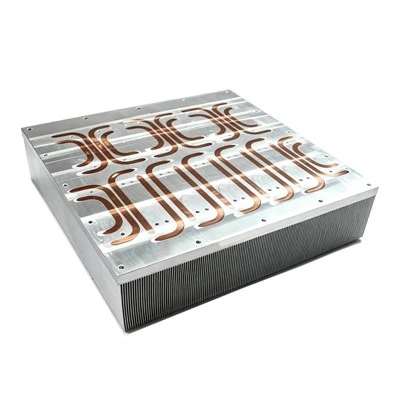
Liquid cold plates are typically made from high-thermal-conductivity metals and feature internal coolant flow channels. During operation, coolant enters the cold plate through the inlet, flows through the internal channels while absorbing heat generated by the heat-producing components, and then exits through the outlet, carrying the heat to an external cooling system.
For power modules in a solid-state transformer, the basic heat dissipation path can be understood as:
Power semiconductor → Thermal interface → Liquid cold plate → Coolant → External cooling system
By shortening the heat transfer path and directing coolant straight to high-heat-flux areas, liquid cold plates can achieve more efficient, concentrated heat removal.
Why Do Solid-State Transformers Need Liquid Cold Plates?
The core function of a solid-state transformer depends on power semiconductor devices to perform electrical energy conversion.
These devices continuously generate heat under high-power, high-frequency operating conditions. As more power is integrated into each unit of volume, the heat dissipation capacity that traditional air cooling can provide may gradually become the limiting factor for further increases in system power density.
Therefore, thermal management for solid-state transformers needs to address several issues simultaneously:
How to quickly remove heat generated by power devices?
How to reduce localized high-temperature areas?
How to maintain a more uniform temperature distribution across power modules?
How to achieve higher heat dissipation capacity within limited space?
How to balance heat dissipation capability with system energy consumption?
Liquid cold plates provide a compact and efficient solution to these problems through circulating coolant heat exchange.
How Do Liquid Cold Plates Cool a Solid-State Transformer?
The working process of a liquid cold plate can be divided into four stages.
01 | Power devices generate heat
Power semiconductors in a solid-state transformer produce losses during electrical energy conversion, converting part of the electrical energy into heat.
02 | Heat transfers to the liquid cold plate
Heat transfers to the liquid cold plate through device packaging and thermal interface materials.
Good thermal contact between the cold plate and heat-generating areas is typically required to reduce thermal resistance.
03 | Coolant absorbs heat
Coolant enters the internal flow channels of the cold plate and passes through the high-heat-flux areas corresponding to the power devices.
During flow, the coolant continuously absorbs heat from the cold plate.
04 | Heat is carried out of the system
The coolant, now carrying absorbed heat, exits the cold plate outlet and enters an external cooling loop for heat dissipation.
After cooling, the liquid re-enters the cold plate, forming a continuous cycle.
Therefore, what a liquid cold plate truly accomplishes is a continuous "heat transfer" process, not simply a reduction in device surface temperature.
Why Do Internal Flow Channels Matter?
For high-power electronic devices, the performance of a liquid cold plate does not depend on material alone.
Internal flow channel design is equally a key factor determining cold plate thermal performance.
Heat generation is not necessarily uniform across different areas of a power module. If coolant cannot adequately pass through high-heat-flux areas, localized hot spots may form.
Therefore, liquid cold plates need to be designed with internal flow channels tailored to the actual heat source distribution.
Proper flow channel design can help:
Improve coolant distribution efficiency
Distribute coolant more rationally across different heat-generating areas.
Enhance heat exchange in high-heat-flux areas
Optimize flow paths for primary heat source areas to improve heat transfer efficiency from solid surfaces to coolant.
Reduce localized hot spots
Improve cooling capacity in high-temperature areas to achieve more uniform temperature distribution across the power module.
Balance thermal performance and pressure drop
More complex flow channels are not necessarily better.
Overly complex channels can increase pressure drop and pump power consumption, so comprehensive optimization is needed among heat exchange capability, flow distribution, and pressure drop.
What Advantages Does Liquid Cooling Offer Over Traditional Air Cooling?
For high-power, high-heat-flux power electronics systems, the greatest value of liquid cooling lies in its ability to provide more efficient, compact heat transfer.
Higher heat dissipation capacity
Liquid coolants have higher heat capacity and heat exchange capability, effectively handling heat generated by high-heat-flux devices.
Higher power density potential
When heat can be removed more effectively, the system has design space to further increase power per unit volume.
More compact structure
Liquid cold plates can be integrated directly near power modules, creating a tighter structure between the thermal management system and heat-generating devices.
More precise thermal management
By designing flow channels around heat source locations, more targeted cooling can be applied to different heat-generating areas.
Better system scalability
As power conversion systems move toward higher power, liquid cooling technology can provide a thermal management foundation for future higher-heat-load applications.
How to Select a Liquid Cold Plate for a Solid-State Transformer
A liquid cold plate is not simply "the higher the heat dissipation capacity, the better."
For solid-state transformer applications, multiple factors need to be considered comprehensively.
1. Thermal load
First, determine the actual heat generated by power devices and the primary heat-generating areas in the system.
2. Heat flux density
The same total power loss, if concentrated in different areas, may impose completely different requirements on cold plate flow channel design.
3. Coolant flow rate
Flow rate affects the cold plate's heat exchange capability and is also related to system pump power consumption.
4. Pressure drop
More complex flow channel structures typically require more attention to pressure drop.
Therefore, a reasonable balance must be struck between thermal performance and pump power consumption.
5. Temperature uniformity
An excellent liquid cold plate must not only reduce the maximum temperature but also minimize temperature differences between different areas.
6. Structural integration
The liquid cold plate needs to match the power semiconductors, thermal interface materials, and the overall solid-state transformer structure.
7. Manufacturing process
The final flow channel structure must also meet practical manufacturing, reliability, and mass production requirements.
Therefore, selecting a liquid cold plate is essentially a comprehensive optimization among thermal design, fluid design, structural design, and manufacturing process.
What Makes a High-Performance Liquid Cold Plate?
There is no single "best flow channel structure" that applies to all applications.
A high-performance liquid cold plate needs to be comprehensively designed based on actual application parameters:
Heat source location → Heat flux density → Coolant → Flow rate → Flow channel structure → Pressure drop → Temperature uniformity → Manufacturing process
Therefore, a high-performance liquid cold plate does not pursue maximization of a single parameter, but rather:
More efficient heat exchange + More rational flow distribution + Lower pressure drop + More reliable structure + Better manufacturing consistency
How Does Pioneer Thermal Provide Liquid Cooling Solutions for Solid-State Transformers?
Pioneer Thermal focuses on advanced liquid cooling and thermal management solutions for high-power electronic devices.
For high-power power electronics applications such as solid-state transformers, Pioneer Thermal can design liquid cold plates based on the actual heat source distribution, power density, installation space, and cooling system requirements of the power module.
By optimizing the internal flow channel structure of the liquid cold plate, coolant is directed more effectively through critical heat-generating areas, achieving efficient heat transfer and removal.
This application-optimized liquid cooling approach can help high-power power electronics systems:
Improve heat dissipation capacity → Control operating temperature → Support higher power density → Achieve more compact system design
Why Are Liquid Cold Plates Important for Future AI Power?
The development of AI computing power is driving continuous growth in data center power demand.
Future AI power systems not only need to deliver greater power but also achieve more efficient electrical energy conversion within limited space.
This means:
Higher power → Higher power density → Higher heat flux density → Higher thermal management requirements
Advanced power conversion technologies such as solid-state transformers provide new development directions for future AI power architectures.
Liquid cold plates bear an important thermal management task within this.
They are not simply a "heat dissipation component," but an important part connecting:
Power devices, thermal management, power density, system reliability, and structural design
Core Knowledge Summary
What is a liquid cold plate?
A liquid cold plate is a thermal management component that removes heat generated by power devices through internal coolant circulation.
Why do solid-state transformers need liquid cold plates?
Because high-power semiconductors generate significant thermal loads, and higher power density places higher demands on thermal management.
How does a liquid cold plate work?
Through a continuous cycle of "device heat generation - heat transfer - coolant heat absorption - heat removal" to achieve sustained cooling.
What determines liquid cold plate performance?
Heat source distribution, heat flux density, flow channel structure, coolant flow rate, pressure drop, temperature uniformity, and manufacturing process together determine its performance.
What can liquid cold plates bring to solid-state transformers?
More efficient heat removal capability, a more compact thermal management structure, and the potential to support higher power density designs.
Why is it relevant to AI power?
As AI infrastructure power demands continue to grow, high-power power conversion systems require more advanced thermal management technologies, and liquid cold plates are one of the important technologies involved.
Pioneer Thermal
Powering the Future. Managing the Heat.
As AI infrastructure and high-power power electronics systems continue to develop, thermal management will increasingly become central to system design.
Pioneer Thermal is committed to providing reliable thermal management solutions for next-generation high-power, high-density power electronics systems through advanced liquid cold plate and flow channel design.
Making higher power density possible. Letting next-generation power conversion systems continuously unlock their performance potential.