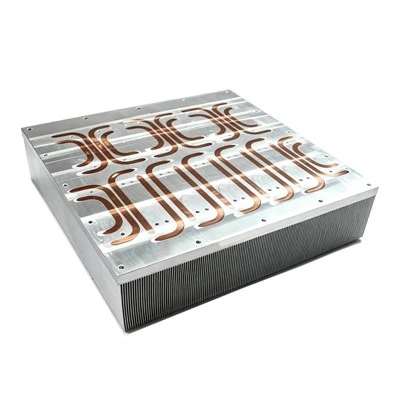

The working principle of a vapor chamber is identical to that of a heat pipe, involving four main stages: conduction, evaporation, convection, and condensation. A vapor chamber is a two-phase fluid device consisting of a sealed container lined with a micro-structured surface and filled with pure water. Heat enters the chamber from an external high-temperature zone via conduction; water surrounding the heat source rapidly absorbs this heat and vaporizes, carrying away a significant amount of thermal energy. Leveraging the latent heat of vaporization, the vapor diffuses from the high-pressure (high-temperature) zone to the low-pressure (low-temperature) zone; upon contacting the cooler inner walls, the vapor rapidly condenses back into liquid, releasing the stored thermal energy. The condensed water flows back to the heat source via capillary action within the micro-structure, completing the heat transfer cycle and establishing a two-phase system where water and vapor coexist. Continuous vaporization occurs within the chamber, with internal pressure automatically balancing in response to temperature fluctuations. Although water's thermal conductivity is relatively low at lower operating temperatures, its viscosity varies with temperature, allowing the vapor chamber to function effectively even at 5°C or 10°C. Since the liquid return relies on capillary action rather than gravity, the vapor chamber is largely unaffected by orientation, offering greater flexibility in system design and allowing for installation at any angle. Requiring no external power and containing no moving parts, the vapor chamber is a completely sealed, passive device.